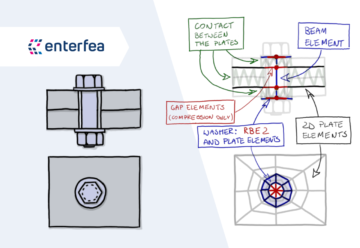
Bolts in FEA [5]: Complex Bolt Model
This is the 5th installment of the “bolt series”. In this article we will discuss: An Advanced Model…
30 September 2024Hey People!
I’ve recently started posting FEA Design Insights on my LinkedIn profile as well as in the Facebook group (where some awesome discussions happen). I figured I will make a roundup with the best (and most interesting) tips here… just so they will be there where you need them!
Let’s start with a roundup post 001!
You can also check the video version on my YouTube Channel!
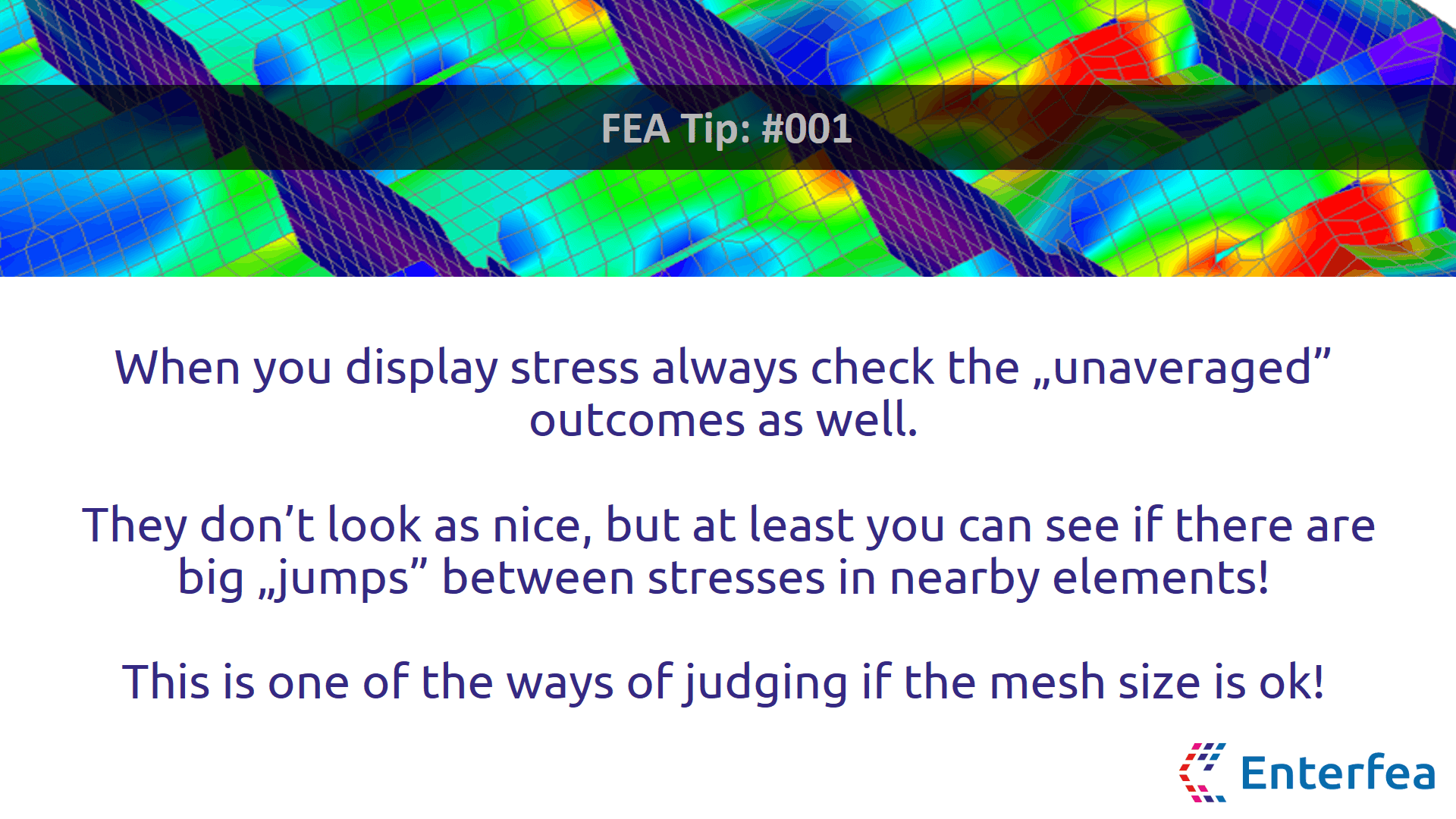
This is an important thing for sure. I’ve made this post, as I was finishing the averaging topic for the FEA course. Let me pull a small example from there really quick!
Nice and smooth average on the left, and unaveraged outcomes on the right!

Those are of course the most basic ways of displaying stresses (there are actually more options in most software). Take a look at how stress distribution changes. This can show you if the mesh is too coarse for instance. If the difference between stress levels in adjacent elements are unacceptable… it’s time for a mesh refinement!

Join my 2h FREE Live Event and learn all that you need to know to start using Nonlinear FEA as an Expert! I will talk about:

In many talks, I have heard from you all that verification and confidence in outcomes are major issues in FEA. I completely get that! This is why benchmarking is so useful. You can solve a problem you already know the answer to… just to check if you know how to solve that problem! Sadly, it’s hard to find good resources. Luckily FEA Guild members came up with some cool references:

This one is connected with a funny story.
I was designing a pipeline, and heaving incredibly rigid support between DN1000 pipe and a concrete slab (pipe was 100mm above the concrete) I assumed that this support was “infinitely rigid”.
When I added the actual cross section (it was welded from 20-30mm plates, pretty complex and rigid shape) thermal expansion forces dramatically changed! All the pipe needed, was to deform this “precious” 0.1mm! Infinitely rigid element just couldn’t provide that, but a “very, very but not infinitely” rigid support could!
The good thing is that I’ve learned this before we shipped it!

To this one I added a small story of mine (as I try to do from time to time):
I was doing contact for the first time, but I figured I will do it easily. So I tried several times in the big model that I was doing (of course with nonlinear analysis and all the jazz). Computing took an hour each time… and each time there was something off!
I wasted a day before I gave up, and make a very simple model with 2 plates. Computing took less than a minute and in several tries, I figured out how things work…
I was a bit afraid that it’s only me who make such mistakes… but luckily comments said that I’m not. I’m not sure if this was a relief, but at least I don’t feel so bad about myself. And you shouldn’t either if you are guilty of this! Just remember:
Trying on big models first will waste a LOT of your time!

What I really love about you guys is that when we hang out (even if only in an FB group!) it’s impossible not to have good ideas! This one came from my discussion with Barmin in the previous tip. The idea is simple…
Sometimes I do a complex FEA analysis simply because I can. Even, if there are quicker ways to solve stuff… or the outcomes aren’t really needed at all!
I guess this is partly because I simply enjoy doing FEA, but I guess that in times I’m too lazy to think if I really need to do this.
As my math teacher used to say: “people rather work for 1 hour than think for 5 minutes!”
But as Aleksei pointed:

And that is true, at least to some degree. Just remember kids “rainbow = job well done!”
I hope you like it. Let me know in the comments what do you think about posts like that. And… if you want to hand out – join our FEA community (it’s fun!).



Share
Join the discussion