
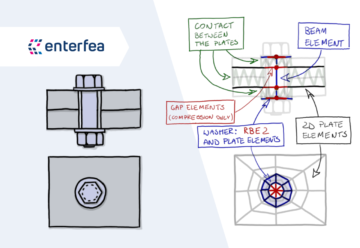
Bolts in FEA [5]: Complex Bolt Model
This is the 5th installment of the “bolt series”. In this article we will discuss: An Advanced Model…
30 September 2024My FEA history started pretty weirdly. I would guess that most folk start with linear FEA, while my first analysis was a nonlinear snap-through problem in shell buckling. Of course, I failed miserably for a very long time, before getting anything useful! Luckily for me, in the meantime, I started my first company. This meant that apart from Ph.D. stuff, I also had to solve “real problems”. And I solved them with linear FEA. It was the only thing I could successfully compute at that time!
I have absolutely no doubt that in practical FEA design, linear analysis is used most often! And there is nothing wrong with that! The trouble starts when you use it, unaware of the problems associated with this approach. Simply put, there is a certain level of “guessing” involved, and you need to be aware of what are you guessing and why, to successfully run a linear FEA design!
I think, my attitude towards linear FEA changed a lot as my skills developed. I remember feeling almost like a hacker when I did my first linear analysis with 2D mesh elements. I was so happy and proud that I made it “work”. Now, I rarely even look at linear analysis outcomes, treating them as something in the background of “real work”. I guess, that the more I knew about FEA, the less I “believed” in linear FEA outcomes… and this is a risk associated with the method I guess!
But let’s not get ahead of ourselves!

There are a lot of things you can do in FEA. My “thing” lies in structural/stability/stress design. So naturally, this is what I will write about. And since we are focusing on practical design, I feel I should point out what we will be interested in (just to avoid confusion).
As you may know, there are several possibilities when it comes to component failure. The ones I encounter the most in my work are:
When we talk about “practical design” I guess it’s pretty safe to say, that we are basically interested in accurately estimating the capacity of our component with respect to the above problems. In some cases, we just need to know the value (like deformations) and compare it to the allowable value. In some others (like stresses) we will also need to “interpret” the FEA outcome. And this interpreting is the hardest part!
But before we get to that, I should also mention that in the “practical world” we should also differentiate:
Two types of design:
Verification of a component: That would be an answer to a question: will this hold? You have a component, and all you have to say is, whether it will work or not under certain conditions.
Optimization: This is the tricky one. You have a component (or sometimes just an “idea” of a component) and the task is to make it as light* as possible. This is way more difficult because it’s not only about “making a call if it is ok” anymore. You actually have to be able to decide where the limit is, to be able to be close to the limit, but not past it!
*Usually it’s about weight, but this is rarely the only factor. Things like being easy to manufacture, thin, machining suitability, or made from elements that are already in stock, come to mind as well.
Knowing all that, let’s take a look at what linear FEA offers us in those fields. I get a suspicious feeling that this will turn out to be a super long post, so I will focus on stress design (the most popular one) here. I guess I will have to write another post about the rest of the problems later!
Imagine you have to do a stress design of a component. I don’t really care what that would be. You know… a thing!
I instantly assume, you know how to correctly support it, load it, mesh it, etc. So you are actually able to obtain linear FEA outcomes that are reasonable. If you can’t do those things, the rest is irrelevant. Everything written below here hinges on this assumption, that the outcome you’ve got from Linear FEA is actually correct!
If you are doing the stress design, the outcomes will look something like this:

Note, that the above is the same outcome from linear FEA analysis (I just adjusted the color scale on the right one to show the upper limit as the yield stress of this steel).
As you can see, as soon as you start using linear FEA is stress design, you hit a wall! It’s super easy to get stresses higher than yield! And a good question is… should those be allowed? And if so… to what degree, and how do we measure this?
I often hear engineers critique FEA as a method, and I think that obtaining “unrealistic” stresses is at the core of the argument. I won’t even get into why this happens (you can read this post about it!), but I think you will agree with the fact that it indeed happens!
So this is a real problem, and now we have to deal with it!
Let’s go through several common approaches to stresses higher than the yield in linear FEA. And bear in mind that those are completely “universal” since you will face this dilemma in most linear FEA models!

This is a very interesting argument. Furthermore, it is sometimes true! In case of fatigue load, you really wouldn’t like to have yield at all (unless you do low-cycle stuff, but then I’m sure you know what you’re doing!).
But let’s assume that you are “just solving” the problem as static, and there is no fatigue in sight.

Assuming that any stresses exceeding yield results in failure is quite a conservative approach! In our case, it would lead to a much lower capacity than the “real one” (obtained i.e. from tests/real life). While I’m absolutely not saying that this is a “useless assumption”, I have certain reservations about its practical usability. After all, the capacity we would obtain here would be very low!
We don’t even have to guess how low the capacity would be! Since this is a linear problem it’s brutally simple to calculate the “allowable load”. When we applied all the loads, we got 1038MPa of stress (442% of the yield stress). To get 100% of the yield stress we just have to apply 1/4.42 = 22.6% of the load. Since in my case I applied a 100kN of vertical force at the end of the cantilever (it’s a bit longer than what you can see above), then to get “perfect” yield stress and nothing more, I would have to reduce the load to 22.6kN. And this would be the outcome of the assumption that we cannot allow stresses higher than yield.
In other words, with this assumption, our connection is way too weak!
While it’s cool that everything in linear analysis can be calculated with a simple proportion, the outcome isn’t all that “cool”. Or at least it’s very conservative!

This is a critique of FEA that I often hear. Everybody knows that steel yields, and that at 235MPa you simply get more strain under the same stress. This means that “for a long time” (entire plastic plateau!) you cannot obtain stresses higher than yield! This basically means that the higher stress we obtained in our analysis is “fake”. Some folks would even refer to this problem as “FEA error” – since it’s quite obvious that FEA computed a “wrong answer”.
Sadly, this is a bit more complex than that. And while I completely agree that the stress above yield we got there is “fake” – this doesn’t mean that FEA made any mistakes! It’s just the result of our assumptions! Since we decided to solve the problem in a linear way, we also assumed that the material will retain a linear relationship between stress and strain. This is true for steel… but only until you reach the yield stress. And the outcomes we see, are just a product of our false assumption.
So sure, those stresses won’t look like that in reality, because steel isn’t as linear a material as we assumed. But does that mean that we can ignore that stress?
This is an awesome question, isn’t it? But I will use a tricky way of answering it. At the start of the answer, let me just say that I strongly feel that “just ignoring unrealistic stresses” is rather dangerous! Imagine I would apply a load that is 10 times higher. We would get the “peak stress” of 10x 1038 = 10380 MPa! Would you be inclined to ignore that stress as well?
And this is the “core” of the problem. While not ignoring stress at all is very conservative, ignoring too much… is plain dangerous! So the beautiful solution is…

Since you already know that not ignoring stress is conservative, and always ignoring it is dangerous… the only question that remains is:
When the heck can I ignore the stress higher than yield in linear FEA?
I feel that this is the “fundamental” question in linear FEA… and it’s a super difficult one! Instead of giving you a direct answer that simply doesn’t exist, let’s think about it this way:
If the maximum local stress in the static design of a component from steel with a yield stress of 235MPa would be 235.1MPa… would you ignore it? I’m willing to guess that you would, right? After all, it’s a very small difference, some yielding will just happen and things will be ok. I mean, c’mon that is only 0.04% difference. I’m sure you would agree, eh?
And how about 50 000 MPa? I guess you would say that you cannot ignore such high stress, right?
Awesome! We just established that some stress values obtained from linear FEA can, in fact, be “safely” ignored. But there are also those, that cannot be ignored at the same time!
But this is not the end of the trickery… let’s dive deeper!
We already agreed (I hope!) that one can ignore stress higher than yield by 0.04%. But let me add a “twist” to this question. Imagine a round bar in pure tension. And then, on the entire cross-section, you get stress higher than yield by 0.04%. It isn’t the same right?
I mean, it’s one thing to ignore the small “local” place where the stresses are higher than yield… but when this “area” is getting bigger and bigger… things will become problematic, right?
This means, that when you are asking “can I ignore this stress higher than yield”, you are basically asking two questions:
Getting an answer will be super tricky for sure! But there is also something else, and that is engineering intuition!
Guessing as a way of life!
If you are doing a “verification design” (i.e. not optimization) such linear FEA outcomes often can be ok!
You see, it’s a completely different thing to be able to say “where exactly the limit is” and a much simpler thing to say “this looks acceptable for me!”.
Simply put, if the component is ok, you will most likely be able to judge this even by looking at linear FEA stress plots. Similarly, if the component is significantly too weak, you will spot this right away!
The problem comes, when you are “really close” to the actual capacity, especially when you do the “optimization” of a component. Then, such answers are just not enough!
As you can see, while I know a bit about the model and about the phenomenon, I’m still guessing if the outcomes from linear FEA are “acceptable”. And while it may be an educated guess, basing the prediction on such linear FEA outcomes is still a guess!

But then, how are folks using linear FEA in design, then?
Well, the short answer would be that they are good at guessing. But that would be a very shallow one as well! This guessing has much more to it than meets the eye!
Imagine you are an engineer responsible for testing 100 sample connections in the laboratory. But the lab has a “funny procedure”. They ask you first to do a linear FEA of the problem, and “guess the outcome”! Only after you submit your guess, will you be allowed to do the actual test.
I’m pretty sure, that your first guess would be pitiful, that way or another. You do the FEA, guess the number, and then see the actual result. A complete “miss”. But at the same time, you learned something! You saw, what FEA showed as an outcome, and how actual failure looked like.
Before test 2, you already know a bit! So now you look at your FEA differently. But again you submit a guess, and you miss. Perhaps you are a bit closer but it is still a miss. Also, you notice that this connection is slightly different in geometry than the previous one, so things work a bit differently.
And then you do the 3rd test, the 4th, and so on. Each time you know a bit more, you see the behavior and you learn to “interpret” the FEA outcome. But this is not entirely an FEA thing. You also gain an understanding of how those connections work. This also gives you the “lenses” through which you can analyze the outcomes linear FEA gives you! And what is also super important… after you start to consistently “guess correctly” the capacity of the test samples, you also start to believe in your skills of doing so!
I’m pretty certain, that after 100 similar connections, you would be able to pretty nicely estimate the capacity of the connection, based on linear FEA outcome!
But this doesn’t change the situation, that on that first try, you got it horribly wrong! And that is the thing! You need to have experience in linear FEA, to use it effectively! And it’s super difficult to get that experience unless you work in a lab with very weird procedures (or you do a Ph.D. in a topic that allows it :P).
And finally, after 100 connections, you will be able to nicely estimate a connection capacity of similar connections based on linear FEA outcomes. But this doesn’t mean that you can estimate ANY outcomes. Sadly, this works only for similar sets of problems! So while you are great at assessing the capacity of connections, you may still be at “test 1” without any chance of success (!) when it comes to the buckling capacity of something! It’s worth remembering that!
Experience in linear FEA is super important… but not every experience counts!
After 100 experimental tries, you compared with linear FEA outcomes, I really do believe that you would be super close in the 101st case, based only on linear FEA. This would give you the possibility to more or less optimize structures based on linear outcomes.
While this would be limited to similar things you actually tested, I think that optimization based on linear FEA is actually doable! Sadly, it also requires experience that is almost impossible to get…
Note, however, that if you did FEA for 10 years, and nothing you calculated failed… this is not precisely the same experience. While you know “what goes”, you still have no idea what the limit is! There is no way to actually optimize anything (without significant risk!) with such experience! And I think that this is a very overlooked fact!
After all, you could design stuff with the “no yield” criteria for 10 years. None of them failed… you have 10 years of “perfect” experience. And yet, your designs are super “overweight”… and you don’t even know about it!
I know, that at this point, all of this seems depressing and hopeless! While I’m aware of companies doing lab tests of their products, usually they try to base their future design on nonlinear FEA (much fewer tests are needed to “calibrate” the models, and there isn’t much guessing in that case).
So what would be the best call for linear FEA design? I think that this depends on the situation you are in! But without a doubt…

In light of what I wrote above, it would be super simple to just “stay conservative”. After all, if you don’t allow for ANY yielding, then the linear material model is 100% correct! But is this really a good option?
Honestly, if you are just starting out, maybe this really is a good call. But bear in mind, that this may be an ULTRA conservative position! I will use just a single example to demonstrate what I mean. The below structure “works” while linear analysis of this structure showed stress at 5500MPa… so over 23x higher than yield!

Yeah… so if you “aim” to not have yield stress in the model at all, you would “overshoot” the capacity by a factor of over 20! That could be an awkward conversation with a customer who already has such a thing that works… and ordered a second one from you!
I’ve actually been in such conversations myself! Explaining to someone that the thing you can see through the window of their meeting room should collapse like 20 years ago… As you can imagine, this is an extremely fun experience…
So I guess in time, you will simply start to ignore “some” stresses from linear FEA, just to “fit” into the market. And please don’t treat this as advice! I’m merely sharing my observation with you. It’s a common thing for folks who do linear FEA “long enough” to ignore stresses higher they yield. Some do it more, some less. But they do it. I think that this is the only real way you can use linear FEA in the actual design.
Do I like that way? Absolutely not! I would never go this route myself… today!
That being said… I did it just as a lot of other folks did for a long time! And there are many reasons to do so! First of all, in the early stages of my company, I couldn’t afford a good nonlinear solver. But that is not even the “main problem”. Even if I had that software… I had no idea how to use it!
Simply put, I knew too little (and had too few resources) to do anything else… and yet I needed to do the job anyway! Somehow, the market doesn’t ask you if you CAN do the job… they just want to know when you will be done, and how much you want for it! So if you are in this place… I feel you! I’ve been there myself!
This is a tough situation, and I guess that my advice in such cases is…
Linear FEA is the most common approach for a reason! It really helps in the design and is relatively easy to get access to such a solver (not to mention that it is easy to use!). Many people used this before (me too!) and many people will use it in the future as well! So you doing this isn’t anything vulgar. And I think that, even after everything I wrote above about the uncertainty, guessing, and the “impossible experience” that is needed!
Just don’t treat it as an end-goal! Treat it as a stage! Use this time to learn as much as you can, develop your skills, and get ready to use nonlinear stuff. If you run your own business saving up the hard-earned money for better software is a good thing as well! Just don’t get “stuck” in this zone – trust me it gets better!
I suppose I have just stated that you will have to ignore stresses higher than yield (at least to some degree!). While I cannot stress enough how careful you should be, I really think that this may be needed! And the cool thing is, that the more you understand about nonlinear stuff, the easier it will get for you!
But does that mean, that you can always ignore insanely high stresses in linear FEA? Absolutely NOT!
After all, a simple plate in tension cannot really have stresses higher than the yield at all, as it would fail otherwise (not including the strain hardening, but you know what I mean)! It all depends on the situation… and this is the super problematic thing!
Join my 2h FREE Live Event and learn all that you need to know to start using Nonlinear FEA as an Expert! I will talk about:
Sometimes, playing it safe is a great call! On other occasions, it will make you look like an idiot! Sometimes 5000MPa of stress is acceptable in linear FEA, sometimes even 250MPa (for S235) is just too much! In some models, a big yielding area will be ok, but in others, small areas may lead to serious trouble! I think that your engineering knowledge and experience will be a great guide here (at least it should!). Just treat linear FEA as a great “backup plan”, and a tool that can aid you in understanding how things work. But never base your designs on linear FEA alone… unless you happened to work at that lab, and you are doing the 101st problem now!
All in all, you need to have a lot of experience in a particular set of problems, to be able to use linear FEA in design effectively. But if you treat it as an “aid” in your design, it will help you a lot even before you are experienced. Just don’t treat it as a “one and only” true source of wisdom!
And if you haven’t solved a lot of similar problems before… basing a design on linear FEA, may as well be guesswork! Educated guesswork perhaps, but guesswork all the same! Never forget that!
I really hope that this post got you thinking a bit. Or maybe you already knew this all? Or, maybe you completely disagree? I hope that we can start a discussion in the comments below, about how we can responsibly use linear FEA in design, and help each other out in this step of our careers!





Share
Join the discussion