
Prerequisites for studying FEA
To design stuff with FEA you will need engineering design skills. But what are those skiils, and what else will you need? Let's check!
5 October 2021Since I announced the Q&A column on my blog I got several great questions so far. I will try to answer as many of them as possible at the end of each month. If you have sent me a question and you didn’t find an answer here no worries! I store all of them and I will answer them later on!
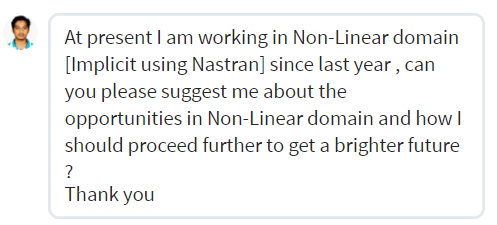
I like questions from LinkedIn simply because they look so nice and professional when inserted into the post 🙂
I think however that I would reframe the question a bit. Nonlinear analysis is not a career field… just as using Excel is not a career field. Sure this is a skill that gives you tremendous opportunities, but never “alone”. This is a tool you can do a lot with… as long as you know what you want to do with it.
In other words, don’t invest in the nonlinear FEA “alone”. This would mean you are like a “calculator operator”. Someone wants to have something solved, so they came to you. They tell you more or less what is required and ask you to do it. A typical corporate job. There is nothing wrong with this of course, but I feel that the “true power” of nonlinear FEA lies elsewhere.
Before I started blogging I have spent 8 years (not counting studies) learning about structural stability in various problems. During that time I also learned FEA – but I started that few years along the way. I realized how big potential this method has. Since I already knew what I wanted to do I could appreciate the possibilities FEA gave me. I was aware of the problems in stability, and nonlinear FEA was an answer to those problems.

In other words, try to be an expert in some fields other than nonlinear FEA and use FEA there. No worries it is not a choice for life! Simply don’t learn only about convergence, mesh refinements, etc. Learn also about any industry you think nonlinear FEA will be useful. The more you know about this one industry, the more you will appreciate the possibilities nonlinear FEA has. But also you will be able to define problems and propose solutions on your own. This will give you tremendous freedom of choice! After a while, you will know a lot about one industry. Thanks to this you will be able to “expand” into fields that have similar problems etc. From there it gets easier 🙂

Join my 2h FREE Live Event and learn all that you need to know to start using Nonlinear FEA as an Expert! I will talk about:
My field was stability, which leads to shell stability and things related to different solver approaches, convergence issues, etc. Then I expanded into thin-plate structures, simply because their issues are similar, and I learn this now. Later… who knows maybe dynamic stability or laminates? I will see where life will take me 🙂
If I would focus only on nonlinear FEA I would most likely know more about it now. But I woul not be able to design anything myself. I would not know what to search for, and where the problems may be.
Nonlinear FEA is not a goal. It is a great tool that will help you to reach your goals. But it’s up to you to know what you want to use it for!
Where to start is a difficult question. Since you already use nonlinear analysis you have solved some problems already. If you are lucky they were from different fields. Just pick whatever you feel is interesting and go there. If you are unsure what to do, try to reach out to people on LinkedIn that do something similar. Ask them if nonlinear FEA makes sense in that field, what problems are there to solve etc. I’m sure you will find help from others, just as I’m helping you right now.
Good luck!
It seems that with the last post I invoked a series of questions about stability. This one was special as I had a chance to talk with Grzegorz for half an hour on our latest Enterfea Hangout. If you missed this, no worries. I will do more of those in the future.
Grzegorz was curious about the stability of a structure he designed some years ago as a diploma thesis. I must admit that idea of the structure is pretty interesting – definitely worth taking a look:

There are 3 main components here. “Horizontal” girders aren’t of course “flat” but they are on the surface of the roof. They provide stiffness more or less in the horizontal direction. The second important elements are the vertical trusses. Those are rigid in the vertical plane. Finally longitudinal beams “tie” this lot together.
Grzegorz was curious how I would approach the design of such a thing, so let’s give it a shot 🙂
First of all few observations.
I would approach this problem with the following tools:
I intend to have a Q&A post each month. If you have any questions feel free to ask me on LinkedIn or simply leave a question in the comments below!
Also, let me know what you think about Q&A posts – is this a good idea? Do you find this useful, and should I continue them?

Share
Join the discussion