

Rigidity of GAP elements in contact
GAP element rigidity will depend on the material of the parts in contact... and also on the mesh size! Learn how to calculate it!
12 December 2022Recently I’ve checked what topics are the most popular on my blog and it seems meshing is in high demand ( :
I also figured I will try something different as a style of writing. This post will be a list of few short ideas instead of a long article about something. Let me know in the comments below if you would like to read more posts like this one in the future : )
Few ideas about meshing you may use/enjoy:
I think that for whatever reason solid elements are completely overused! This is especially true with elements made of thin walls where shell/plate elements are simply better.
I think this comes with the fact that a lot of analysts associate solid (especially brick) mesh with “quality”.
Unfortunately, this is not always the case, and in most of the thin plate models, 2D elements will give much better results, with a much smaller node count (or DOF count if you prefer this metric).
It is worth remembering that you will need several elements across thickness to capture things like bending. Usually, you don’t want to use bricks so small!
I get the feeling that often people either ignore mesh refinement altogether or go absolutely crazy with it! The trick is to increase the number of elements where stress changes rapidly. Where stress is more or less constant big elements are ok.


Join my 2h FREE Live Event and learn all that you need to know to start using Nonlinear FEA as an Expert! I will talk about:
Of course, this is not the only metric, as a phenomenon like buckling can easily happen in constant stress zones and require a “reasonable” mesh to catch them.
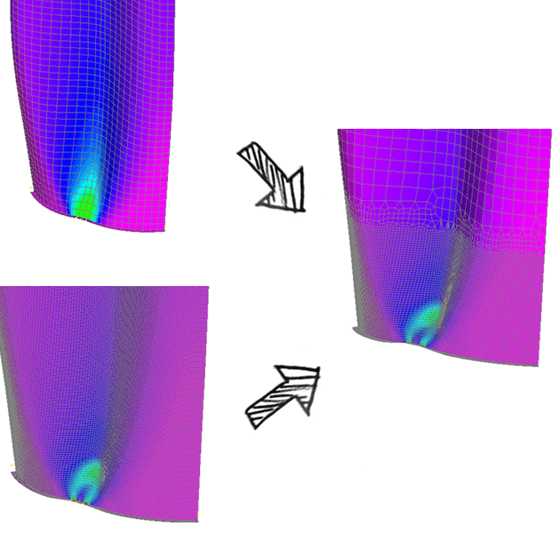
However, usually, you already know where things “will happen”. Just don’t overdo the meshing and use a proper amount of elements. Too little will cause errors in outcomes, too much elongate computing into infinity… or at least “practical infinity” : )
When meshing, don’t forget to place nodes where you will need them later. Maybe you will like to apply a load or a boundary condition in the middle of the plate – it would be great to have a node there right?
Usually, you will mesh a model based on geometry. Just remember to make a geometric point where you want to make a support/load or two intersecting lines. This way with mesh generation node will be generated where it is needed!
This is also a good time to mention that assigning boundary conditions and loads to geometry makes a lot of sense. If you will remesh the model later (i.e. for mesh refinement) you won’t have to redefine anything!
If you read an FEA book or attend an FEA course you have already heard this: don’t use point supports!
You know the “point has zero area so stress is infinite” thing. While it makes certain sense the application of this principle is strictly limited.
You see, there is this wonderful Saint-Venant’s Principle. It simply says that if you are “far enough” it doesn’t really matter how you apply loads or boundary conditions, as long as they are “statically the same”.
In short, this means that if the load you apply to a point is the same as the resultant of area load, at a sufficient distance it doesn’t matter how you applied the load.
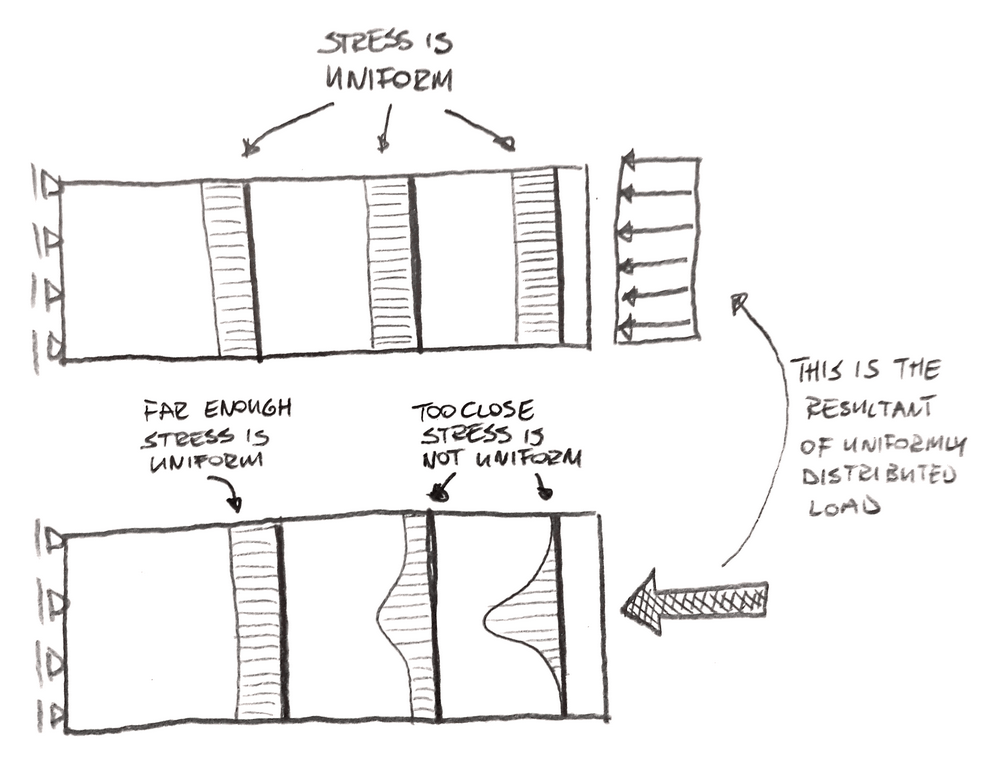
Sure, there is always a question “how far is far enough”, but usually it is easy to see! Just be careful with shells… those are nasty when it comes to using this technique : )
Before you even start meshing spend some time thinking if you really need all that junk in there. I don’t know how you roll, but it seems I try to be God-like with my oversized models! You know… make one model of everything, press calculate, and get the answers for all the questions people will ever have.
I’m constantly working on this, so if you have this problem too maybe we should work on it together?
Usually, there are parts of the model that can be removed or changed for mass or simple beam element connecting stuff.
Not to mention that you should use symmetry when you can! Otherwise a small FEA kitten doesn’t get its biscuit.

* I admit that I’ve read somewhere that small kittens help in growing a blog : P
Just don’t overfeed the cat. Remember that if the model is symmetric it doesn’t mean that you can already use symmetry. The response of the model needs to be symmetric as well! Just be careful with buckling and vibration analysis!
Let me know in the comments below what do you think about such posts!





Share
Join the discussion